

AMAT Spin Motor Repair & Refurbishment: Restoring Failed Motors
When a direct-drive spin motor fails on an AMAT ion implanter, the tool goes down — and the cost of that downtime almost always outweighs the cost of...
4 min read
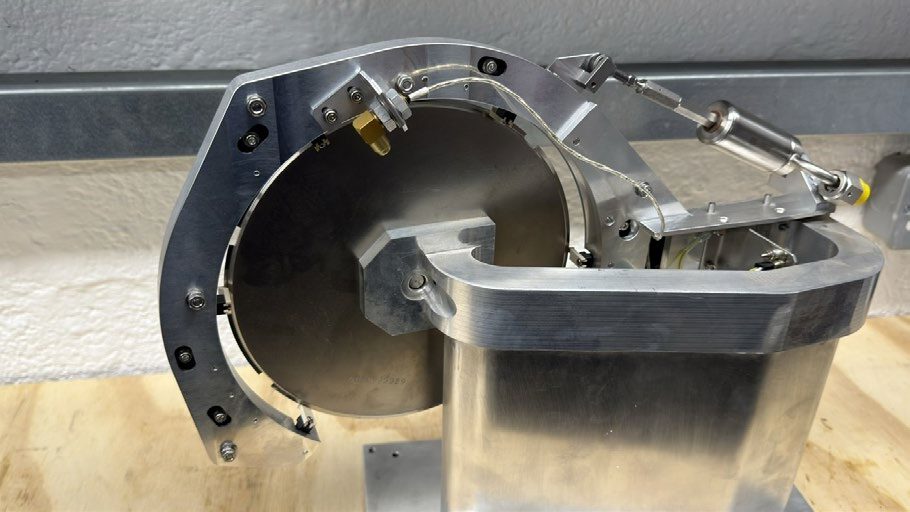
From CAD model to finished, inspected assembly, IES Semiconductor Parts builds the 200mm/8-inch hollow gripper entirely under one roof for 9500, XR80 and XR200 ion implanters — one of the most demanding components on an AMAT high-current end station.
Every ion implanter that processes a 200mm wafer relies on a component most people never think about: the hollow gripper. It sits on the high-current end station, holds the wafer at the edge, and has to keep it perfectly still through high-speed rotation, under vacuum, thousands of times a day. When it wears out or fails, the tool is down — and on a production line, that's expensive.
At IES Semiconductor Parts, we manufacture the complete 200mm hollow gripper in-house at our semiconductor engineering centre. We don't outsource any stage of the process. That means we control quality, accuracy and lead time from the first CAD model through to a finished, inspected and fully assembled unit, ready to fit straight back onto the tool.
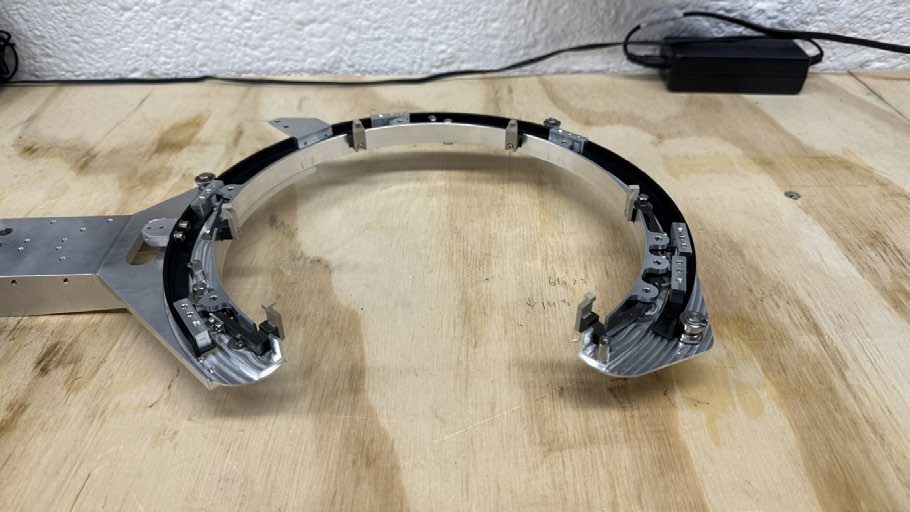
A hollow gripper is the wafer-handling end effector fitted to an AMAT high-current ion implanter end station. It clamps a wafer securely at its edge while leaving the centre open, allowing the wafer to spin at high speed under vacuum without anything contacting its working surface.
Because we own every stage of the process ourselves, nothing gets handed off to a third party partway through. Here's how a gripper comes together at our semiconductor engineering centre.
Every gripper begins as a complete 3D CAD model. We define the critical datums, tolerances and mating features up front, so the design is right before any metal is cut. For legacy AMAT assemblies where original drawings no longer exist, parts are carefully reverse-engineered and re-modelled to faithfully capture the original form, fit and function.
The model then goes into CAM, where we develop the machining strategy: roughing, rest-machining and finishing tool paths, tuned specifically to the part's thin walls and deep pockets. Feeds, speeds and step-overs are chosen to clear material efficiently while keeping cutting forces low, protecting both accuracy and surface finish.
Programs run on our CNC machining centres using purpose-built, zero-point workholding, so parts can be located — and relocated between operations — with repeatable precision. Work offsets are set and verified on the machine before cutting, with every feature referenced back to the correct datum.
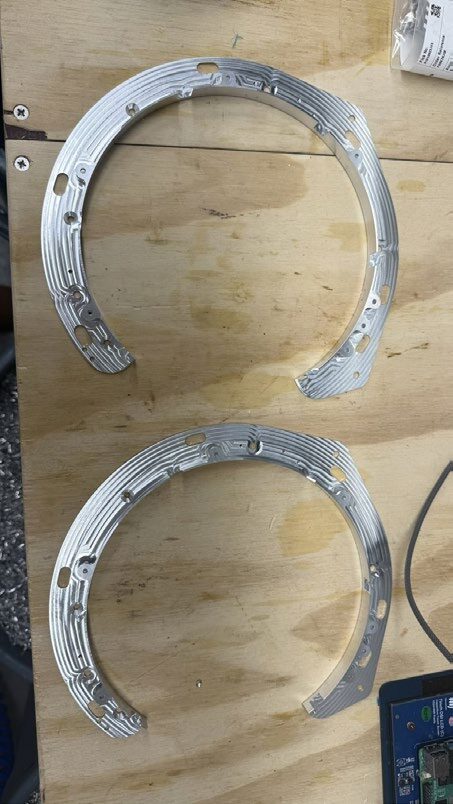
This is what makes the 8-inch hollow gripper such a difficult part to produce well. Its walls are exceptionally thin, leaving very little material to resist cutting forces and distortion across a large diameter. Holding the required accuracy and surface finish on something this delicate took extensive process development: careful fixturing, light finishing passes and a refined tool-path strategy, built specifically to produce flat, stable, distortion-free components every time.
Machined components are deburred, cleaned and dimensionally inspected before wear pads, fingers and hardware are fitted. Each sub-assembly is built and checked to confirm the fingers, clamps and mechanism move and locate exactly as designed.
Final assembly is carried out on our custom in-house setup jig, which holds the gripper at a known, repeatable reference point so the wafer fingers can be aligned and set precisely. Every gripper leaves our semiconductor engineering centre with its fingers set to the correct positions and grip geometry, ready to fit straight back onto the tool.
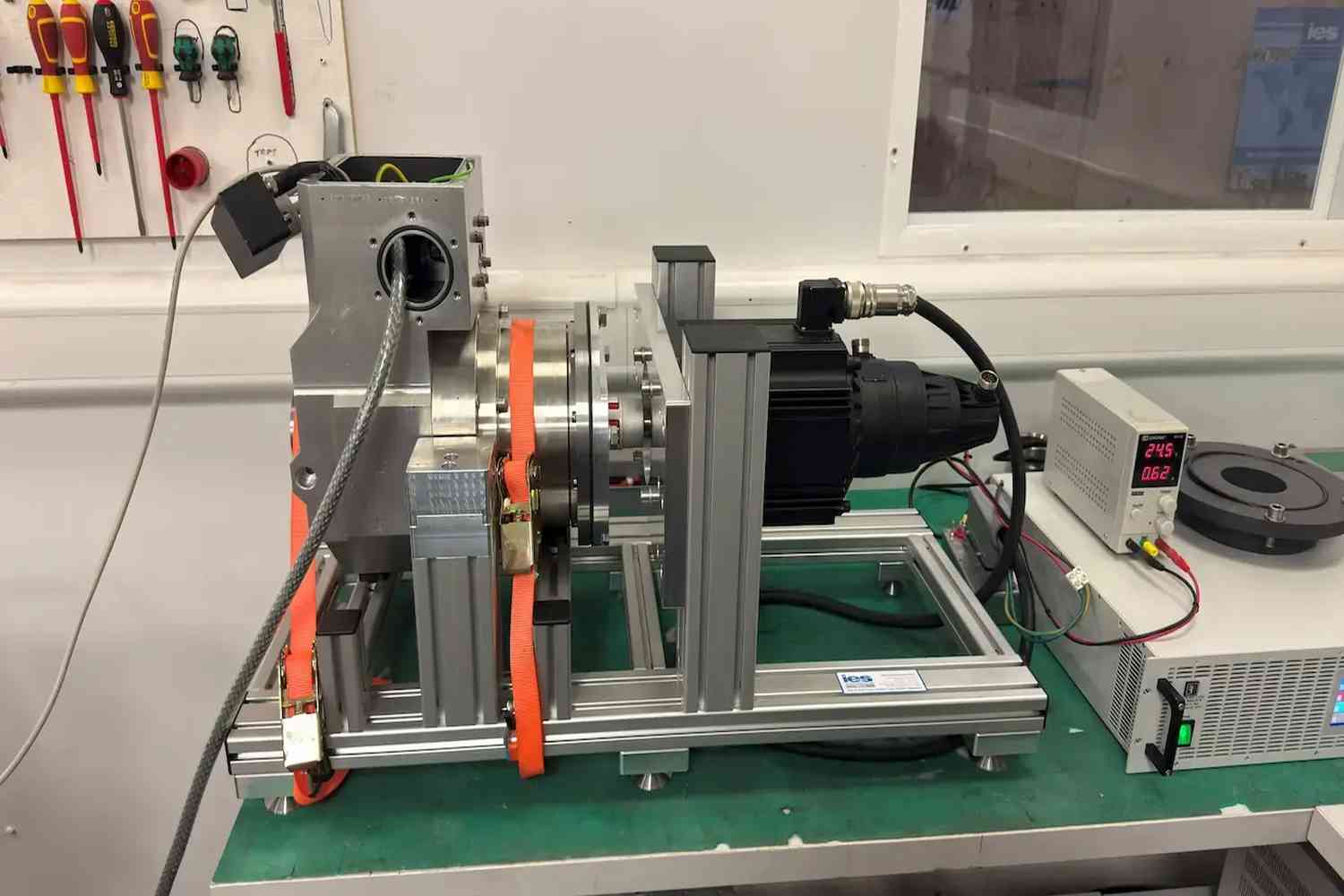
We have a workshop where we have various test equipment set up now, and jigs for testing... because of all the parts we have, we could replicate some elements of the tool for testing.
— Niels Morch, Head of Semiconductor Parts, IES Semiconductor Parts
● Complete in-house manufacture — CAD, CAM, machining, assembly and inspection all under one roof at our semiconductor engineering centre
● Proven thin-wall expertise — a process developed specifically to hold accuracy and surface finish on this demanding part
● Repeatable setup — a custom wafer-finger jig for precise, consistent finger alignment on every unit
● A large parts inventory — complete grippers and individual components held in stock for rapid dispatch
● Full traceability — every assembly dimensionally verified before it leaves us
This approach isn't unique to the hollow gripper. It's how we think about parts generally: fabs running legacy ion implanters need components that behave exactly like the originals, with no compromise on quality just because a tools is older.
We want to provide a high-quality service — that's what we're all about... the job has to go well every single time.
— Niels Morch, Head of Semiconductor Parts, IES Semiconductor Parts
| Product | OEM Number |
| 300mm Hollow Gripper (Amat) | OEM Part Number:9010-00456 |
| 200mm Hollow Gripper (Amat) | OEM Part Number:0010-91470 |
| Hollow Gripper Assy 6" 150mm (Amat) | OEM Part Number:0020-82956 |
| Hollow Gripper Assy 8" 200mm (Amat) | OEM Part Number:0010-99113 |
It's also why we take on the parts that others can't. Most OEMs stop supporting older tools once newer models arrive, which is exactly when in-house manufacturing capability like ours matters most to fabs running 9500, XR80 and XR200 implanters on the fab floor for years to come.
We do quite the opposite. We offer complex solutions. And that means you can't just open a manual and find a simple solution — you have to work from experience and knowledge.
— Niels Morch, Head of Semiconductor Parts, IES Semiconductor Parts

When a direct-drive spin motor fails on an AMAT ion implanter, the tool goes down — and the cost of that downtime almost always outweighs the cost of...
When the rings inside an ion implanter's high voltage stack begin to fail, voltage stability goes with them. Here's how IES Semiconductor Parts'...
A gas panel doesn't have to run for a single hour to develop a leak. Here's why IES Semiconductor Parts pressure and leak tests every gas panel...